Bridging Music and Coding

Introduction

Welcome to Bridging Music and Coding! I’m excited to share a unique approach to understanding data structures by drawing parallels with musical concepts. With over 20 years of experience teaching music theory, I’ve always been fascinated by the structured beauty of scales, chords, and harmonic progressions. Now, as I dive into the world of coding, I see similar patterns that resonate with the concepts I teach.

In this series, I’ll connect data structures with musical analogies to make learning coding both intuitive and fun. Let’s start with a fundamental concept in coding—linked lists—and explore how they relate to something familiar in music: the C Major scale.


Linked Lists and the C Major Scale

A linked list is a data structure in coding where each element (called a “node”) points to the next one in line. This setup is much like a sequence of notes in a melody, where each note leads to the next. In this post, we’ll create a linked list in Python to represent the C Major scale and see how we can play it note by note.

Linked List in Music Terms

Imagine each note in the C Major scale (C, D, E, F, G, A, B) as a “node” in our linked list:

  • Each note knows only the next note in the sequence.
  • To play the scale, we start at the beginning and move from one note to the next until we reach the end.

In Python, we can create this linked list structure by defining two classes: Note (each individual note) and CMajorScale (the full scale as a linked list).


Python Code for the C Major Scale Linked List

Here’s the code to build a C Major scale using linked lists. Feel free to copy and paste this into your coding environment to see it in action!

#PYTHON
# Each note in the C Major scale becomes a node in our linked list
class Note:
    def __init__(self, value):
        self.value = value    # The note (C, D, E, etc.)
        self.next = None      # Link to the next note

class CMajorScale:
    def __init__(self):
        self.head = None      # The start of the scale (first note)

    def add_note_to_scale(self, value):
        new_note = Note(value)
        if not self.head:     # If the scale is empty, start with this note
            self.head = new_note
        else:
            current = self.head
            while current.next:  # Move to the end of the scale
                current = current.next
            current.next = new_note  # Add the new note at the end

    def play_scale(self):
        current = self.head
        while current:
            print(current.value)  # "Play" each note in order
            current = current.next

# Creating the C Major scale
c_major_scale = CMajorScale()
c_major_scale.add_note_to_scale("C")
c_major_scale.add_note_to_scale("D")
c_major_scale.add_note_to_scale("E")
c_major_scale.add_note_to_scale("F")
c_major_scale.add_note_to_scale("G")
c_major_scale.add_note_to_scale("A")
c_major_scale.add_note_to_scale("B")

# Playing the scale
c_major_scale.play_scale()

Explanation of the Code

  1. Note Class: Represents a single note in our linked list, with a value (the pitch) and next (the link to the following note).
  2. CMajorScale Class: This represents the full scale.
    • The add_note_to_scale method adds each note in the order of the C Major scale.
    • The play_scale method “plays” the scale, starting at the head and moving through each note until the end.

When we run play_scale, it outputs each note in the order: C, D, E, F, G, A, B, just like playing through the C Major scale.


Final Thoughts

I hope this introduction to linked lists through music makes the concept easier to grasp. Just as each note flows to the next, data in a linked list connects in sequence, making it ideal for situations where we want to maintain order with flexibility in adding or removing items.

Stay tuned for the next post, where we’ll explore Stacks and Queues and see how these structures are like building chords or rhythmic patterns. Happy coding and music-making!

How might you modify this linked list to allow for reverse playback of the C Major scale?

  • Hint: Consider adding a previous pointer to each Note, turning the linked list into a doubly linked list.

#LydiaBandy #LydiasPianoStudio #MusicandCoding #LinkedLists #CMajorScale #MusicTheory #DataStructures #Tech #SoftwareEngineer #TechInterview

My Interview at Joy of Coding Academy

Bridging Music and Technology!

I want to extend my deepest thanks to Dr. Emily Hill for the opportunity to be interviewed about my experience as part of the Joy of Coding Academy community. It was an honor to discuss my journey, both in music and in tech, and to share insights into how these two fields intertwine.

If you missed the conversation, you can watch it here: Coding Rockstar.

As I continue my path as an intern at TechJoy Software, I am thrilled to apply what I’ve learned as both an award-winning music educator and a professional musician to the world of technology. Whether it’s developing personal projects like a practice log for my piano and harp students, or collaborating on larger tech initiatives to bring impactful solutions to the world, I’m excited about the road ahead.

The future is bright, and I can’t wait to see how I can continue Bridging Music and Technology to inspire and innovate!

Questions for You:

  • How do you think music and technology complement each other in today’s world?
  • What projects or experiences have inspired you to blend creative and technical skills?

Looking forward to your thoughts!

#LydiasPianoStudio #LydiaBandy #SoftwareEngineer #musicandtech #music #musicandcoding #harpist #pianist #musicteacher #tech #coding #codingjourney #intern #musictheory

LydiasPianoStudio Coding Journey Update


Time for a LydiasPianoStudio Coding Journey Update!😀👨‍💻👩🎹🎵💘💻

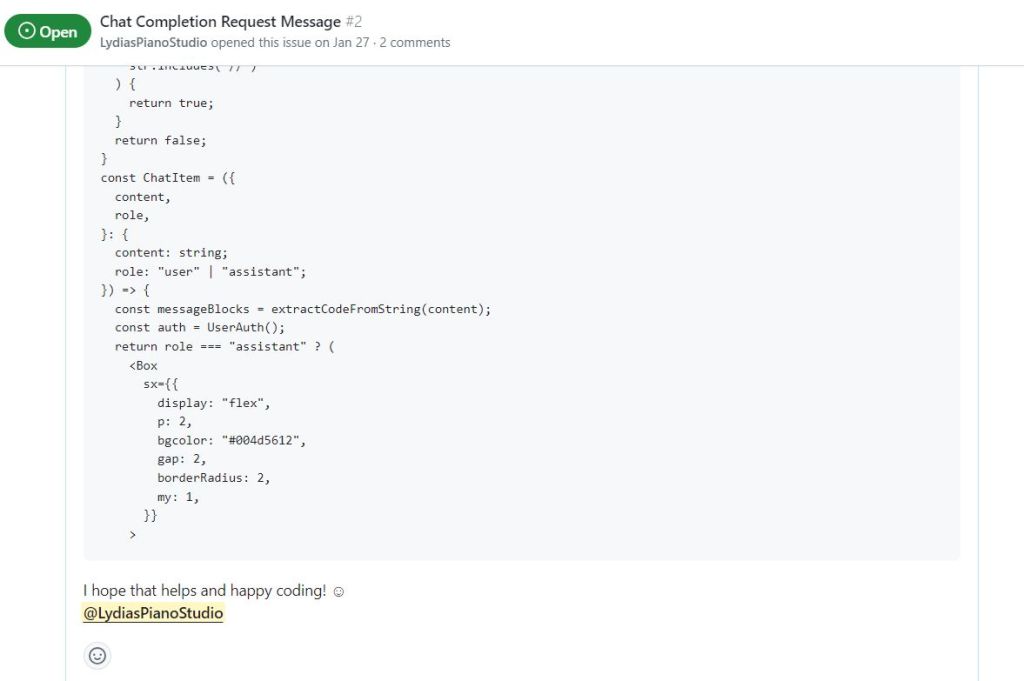
👋 Allow me to share a recent highlight from my coding journey. While diligently following a tutorial on  @FreeCodeCamp, I encountered a pivotal moment. Midway through the tutorial, I stumbled upon an issue: the provided code in the open source documentation for { ChatCompletionRequestMessage } and { OpenAIApi } was outdated.⌨💻👨‍💻

Driven by a passion for problem-solving, I embarked on a quest for a solution. 🕵️‍♂️ After thorough research and experimentation, I successfully devised a corrective code. Eager to assist fellow learners, I promptly shared my findings on GitHub. 😉👍

Guess what?🤩 My contribution struck a chord within the developer community, racking up 5 likes and sparking messages from peers in need of guidance. 🌟 It might seem small, but for me, it’s a big win in my coding journey, especially considering it happened during my first major project: crafting a MERN Stack Chatbot clone.🤖😀👨‍💻

Code provided here: https://github.com/Nikhilthadani/MERN-AI-ChatBot/issues/2#issuecomment-2096589823

Looking ahead, I am filled with anticipation as I navigate potential career paths landing my “dream job”.💕⌨💻 Will it be in DevOps, AI, Full-Stack Development, Game Development, Cybersecurity? So many EXCITING possibilities! 😀

I am about to embark on a transformative INTERNSHIP, poised to refine my coding abilities and bolster my confidence as I continue to make meaningful contributions to the tech community! 👨‍💻👩🎹💘🤩👍

Beyond my coding pursuits, I remain dedicated to sharing my passion for performing on the piano and harp 🎵 and extending my award-winning music instruction, both locally and online at http://www.lydiaspianostudio.com, I’m devoted to making every note count! 😀🎹🎵💘

I invite you to join me on this journey of growth and exploration:

Like, share, follow: @LydiasPianoStudio

#LydiasPianoStudio
#LydiaBandy

———————————————————————————————————————————————————————————————————————————————–
#womenintech #womanintech #debugging #github #opensouce #teacher #webdevelopment #softwareengineer #coding #code #computers #computerscience #coder #webdeveloper #MERNStack #React #AI #Chatbot #ChatGPT #FreeCodeCamp #Helping #advice #typescript #nodejs #JS #express #vite #GameDev #DevOps #helloworld #app #fullstack #dreamjob #codingjourney #blog #blogpost #internship #tech #musicandcoding #api #apikeys #openai #openaiApi #ChatCompletionRequestMessage #opensource

My Coding Journey In Becoming a Full-Stack Web Developer

Johnny 5 is ALIVE!! 🤖

My Thoughts

My Road to Becoming a Full-Stack Web Developer

It all began in January 2023 when I enrolled in a Full-Stack Development Bootcamp. However, after two challenging months, it became clear that the bootcamp wasn’t the right fit for me. In my quest to find an alternative path, I stumbled upon a vibrant community of self-taught and highly talented web developers. As I delved into the world of coding, exploring resources on platforms like Udemy and YouTube, I found a deep passion for this craft. I relished the process of creating and bringing projects to life. Along my journey, I’ve made several discoveries that have shaped my path thus far:

  1. Imposter Syndrome

As a perfectionist, I’ve often struggled with the feeling that no matter how much effort I pour into a project, it’s never truly complete. Fortunately, I’ve come to realize that I’m not alone in this experience. There are numerous tutorials and videos addressing Imposter Syndrome within the tech world that have provided valuable insights and support. 

  1. Harmonizing Music and Code

Music has always been a part of me, and it’s a facet of my identity that I’ll never let go of. As I navigate my way into the tech field, my musical spirit accompanies me on this odyssey. Surprisingly, there are striking similarities between learning music theory and code. Both involve patterns, rules, repetition, and the joy of creating. Coding, I’ve realized, is like composing a beautiful symphony, with each line of code akin to a note, building a harmonious digital experience.

  1. “Think Like A Coder”

A valuable piece of advice that has been imparted to me by numerous senior developers is the importance of thinking like a coder. This goes beyond merely mastering programming languages, although I’m currently focused on honing my skills in JavaScript and Python. It’s about developing the mindset to effectively tackle the challenges presented in code. I’ve come to relish the role of a detective, always eager to solve the problems at hand, ready to “crack the case.” It feels like the game is afoot, and I’m ready for the challenge!

The FUTURE IS BRIGHT

My goal is to complete my portfolio by the end of 2023, with the aim of applying for Full-Stack Web developer positions in 2024. I invite you to continue this journey with me, and I hope that my story serves as an inspiration to anyone with a dream they’re eager to pursue.

#WomeninTech #Tech #FullStackDeveloper #LydiasPianoStudio #LydiaBandy #ImposterSyndrome #CodingJourney #MusicInTech #DareToDream

Lydia Bandy’s Piano Studio

Piano and Celtic Harp Teacher, Pianist, Celtic Harpist

Lydia Bandy is one of the most sought out PIANO AND CELTIC HARP TEACHERS and MUSICIANS in the Carroll County and Baltimore area. She has been teaching close to 20 years offering quality private piano lessons to beginners through advanced levels from her home studio and local music shops. She earned her BA in Music at McDaniel College and is involved in local music associations and piano competition committees. She was rated the top 5 Piano Teachers of Baltimore in 2022 and Carroll’s Best in Music Lessons for 2022.

Lydia teaches all ages, levels, and works well with autistic and ADHD students. She hosts annual piano recitals and performances that include a variety of styles of music from pop, classical, jazz, rock, and hymns. Throughout the years, her talented students have placed 1st, 2nd, and 3rd in various piano competitions. She loves working with adults and introducing them to music therapy techniques.

Lydia plays both piano and Celtic harp, tailoring selections to your needs and the occasion. Her music and presence add a professional and polished tone for any occasion. She has performed at various locations from libraries, churches, airports, and 5 star hotels and restaurants in the Baltimore area, and volunteered with the USO and performed at BWI airport for the troops being deployed.  She regularly performs assisting living facilities, and hospitals, including in home hospice care. Lydia is an experienced performer available for hire for parties, weddings, memorials, cocktail hour, churches, and similar venues. 

Lydia also is a composer and released “Piano Pearls” in 2011 and available on Spotify and other streaming services. She continues to compose and hopes to release more piano and harp albums in the future.

Explore this site to learn more about Lydia or contact Lydia to request lesson or performance information.

Website: www.LydiasPianoStudio.com

Contact Number: 410.876.3653

Email: LydiaBandy@gmail.com

Facebook/Instagram: @LydiasPianoStudio @LydiasPianoStudio

YouTube: ClassyPianoKeys88 Classypianokeys88

Spotify: Piano Pearls By Lydia Bandy